
Products — Seeders & Planters

Air Seeders, Grain Drills and Precision Planters for Large and Dry Fields

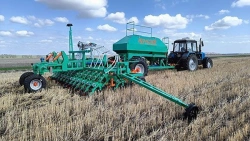
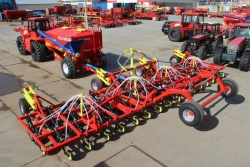
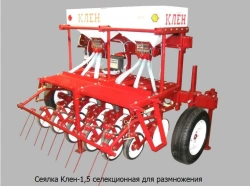
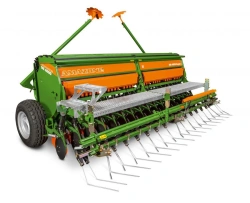
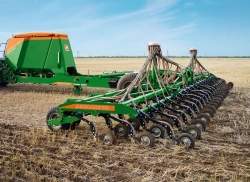
Seeding equipment here totals 282 positions from 54 suppliers, organized around five groups: air seeding complexes (119 listings — the deepest selection), classic grain drills (84), precision row-crop planters (28), combined grain-and-fertilizer drills (14) and small plot seeders for breeding stations. Working widths run from compact 3–4 metre drills up to 12–16 metre pneumatic complexes designed to plant thousands of hectares in a short window.

Russian seeding technology developed around a problem familiar to farmers in Kazakhstan, the Middle East and the African savannah: dry steppe, moisture-saving tillage and the need to seed fast before the soil dries out. That is why the catalogue is heavy on air seeders with wide coverage, hoe and disc openers for mulched or minimally tilled fields, and combined seed-plus-fertilizer placement in one pass. Mechanically these machines stay deliberately simple — ground-driven or basic electronic metering — which keeps them serviceable far from a dealer network.

  • Scale: from 6-row vegetable and row-crop planters to 16-metre pneumatic complexes for grain estates.
  • Agronomy fit: openers and press wheels configurable for conventional, mulch and minimum-till seeding.
  • Fertilizer option: many drills place granular fertilizer with the seed, cutting one field pass.
  • Trade terms: EXW or FOB Novorossiysk / St. Petersburg; wide machines ship partly disassembled with assembly drawings.
  • Support papers: EAC conformity, calibration tables, operator and parts manuals.

Tell suppliers your crop, soil type and tractor power through a sourcing request to get a correctly matched seeder proposal.

FAQ

How much tractor power do the air seeding complexes require?
As a rule of thumb, wide pneumatic complexes need roughly 20–30 horsepower per metre of working width depending on soil and opener type, so a 12-metre unit pairs with a 300+ hp tractor. Smaller mechanical drills of 3–6 metres run behind 80–150 hp tractors. State your tractor model in the inquiry and the supplier will confirm the match.
Can seeders be configured for my crops — wheat, barley, chickpea, sunflower?
Yes. Grain drills and air seeders handle cereals, pulses and oilseeds by changing metering settings, with calibration tables included in the manual. Precision row-crop planters cover sunflower, maize and similar crops using interchangeable seed discs. List every crop you plan to plant; suppliers then include the right disc sets and recommend seed-rate ranges.
How does a 12–16 metre machine fit into shipping containers?
Wide complexes are shipped partly disassembled: frame sections, wings, openers and the seed cart are packed into one or more 40-foot containers or onto flat-racks. Assembly at destination takes a workshop crew several days using included drawings and bolted joints — welding is normally not required. Some plants offer paid commissioning visits or video-call supervision.
What is the typical production lead time before shipment?
Smaller drills are often available from stock or within 20–30 days. Wide air seeding complexes are usually built to order in 45–75 days because frame width, opener type and fertilizer options are fixed per customer. Add sea transit of 30–50 days to Gulf or African ports, or two to three weeks overland to Central Asia.
Do these seeders work in no-till or minimum-till systems?
Many models were designed precisely for moisture-saving agriculture: hoe openers with narrow points, disc coulters and press wheels that work through stubble and mulch. True heavy-residue no-till needs the right opener choice, so describe your residue levels and previous crop honestly. Suppliers will recommend either a suitable configuration or a different model rather than oversell.